
Freshwater Fish of Connecticut
Tiger Muskie
Esox masquinongy × Esox lucius
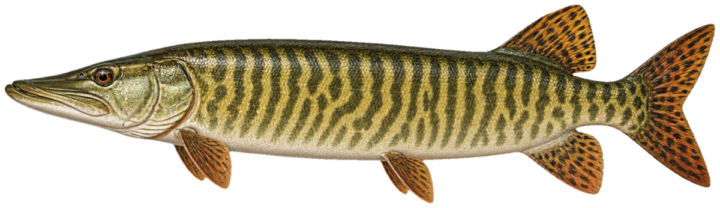
Also called: Tiger Muskellunge, Tiger Musky, Norlunge
Identification
Long, torpedo-shaped pike body with dark, wavy vertical bars (tiger stripes) over a light olive to bronze side and a white belly. Fins are orange-red with dark spots, and the tail lobes are rounded. Unlike a northern pike it has dark marks on a light body, not light spots on a dark body.
Habitat
Larger lakes and reservoirs with weed beds, rocky points and timber. In Connecticut, DEEP stocks tiger muskie in a few waters, including Lake Lillinonah and West Thompson Lake.
Behavior
A sterile hybrid of muskellunge and northern pike raised in hatcheries. An ambush predator that hangs near cover and strikes fast; most active in spring and fall and in low light.
How to Catch
Big spinnerbaits, bucktails, jerkbaits, large swimbaits and live shiners along weed edges, points and drop-offs. Use a wire or heavy fluorocarbon leader — the teeth cut line. A figure-8 at the boat can trigger a following fish. Handle with a big net and long-nose pliers, and release quickly.
Notes
Called the "fish of 10,000 casts" — patience pays. Grows fast and can top 40 inches. Every tiger muskie in Connecticut came from stocking, since the hybrid cannot reproduce.
Regulations
Managed with northern pike: 26-inch minimum length and 2 fish per day (pike and tiger muskie combined), open year-round. Bantam Lake, Little Pond, the Connecticut River and Lake Lillinonah have their own pike rules — check the water body page.
Where to find Tiger Muskie in CT
- Lake Lillinonah Bridgewater / Brookfield
- West Thompson Lake Thompson